Coherence and Perception Failure at Shiloh
Introduction The first day of the Battle of Shiloh (6 April 1862) is commonly interpreted as a case of lost Confederate opportunity—driven largely by the enduring myth that the death of Gen. Albert Sidney Johnston cost the South a decisive victory. In this view, Confederate forces achieved tactical surprise, advanced steadily across the battlefield, and approached decisive success before failing to capitalize on it. This interpretation assumes that the Confederate offensive functioned as a coherent operational system progressing toward a decisive outcome.
This article argues that the assumption is incorrect. Rather than a unified offensive that nearly achieved victory, the Confederate attack should be understood as a system that progressively lost coherence from initial contact. By late afternoon, Confederate forces lacked not only sufficient time but the structural capacity to deliver a coordinated decisive blow. This analysis examines Shiloh at the operational level, focusing on how coherence, perception, and system capacity interact under battlefield conditions, and how tactical success can coexist with—and contribute to—operational failure.
The Problem of Surprise The Confederate attack at Shiloh is frequently described as a surprise. While initial contact did catch elements of the Union army unprepared, the effect of that surprise was limited. The battle began with forward skirmish contact that alerted Union forces. As firing spread, units reacted, formed, and resisted. The engagement expanded outward rather than descending as a synchronized blow.¹ The result was an attack that was unexpected, but not fully disorganizing. Union forces responded unevenly, but coherently. This limitation is operationally significant because the Confederates never achieved the level of disruption required to exploit surprise decisively.¹
From Planned Assault to Fragmented Engagement The Confederate plan envisioned a coordinated advance, but in execution, the attack rapidly fragmented. Terrain—dense woods, ravines, and restricted avenues of approach—disrupted alignment. Brig. Gen. Patrick Cleburne reported in the Official Records that difficult terrain and heavy casualties quickly disrupted unit alignment, with a deep swamp dividing his brigade and forcing him to operate with a split, disconnected command.² This was not isolated; other Confederate commanders described formations becoming intermixed during the advance, with Colonel William Preston Johnston later describing the Confederate lines as becoming hopelessly intermixed, rendering a unified effort impossible.³
By mid-morning, the battlefield was fully engaged but not synchronized, meaning it was not functioning as a single system. The engagement became continuous across the front, but not coordinated across it. This distinction is operationally critical, as continuous pressure does not substitute for concentrated effect.⁴
Continuous Pressure Without Operational Concentration As the battle progressed, Confederate forces maintained forward momentum, but Union forces did not collapse. Instead, they executed a pattern of displacement, re-formation, and renewed resistance. This created a lethal functional asymmetry: the Confederate offensive required massive, synchronized concentration to break the Union army, while fragmented Union regiments needed only local coherence—a few organized lines in the brush or along a ravine—to delay the advance and buy time to reform.
By late afternoon, General Ulysses S. Grant observed that the remnants of his divisions had rallied to form a cohesive defensive front along the high ground. He noted that the position at the Landing, supported by the protective fire of the gunboats, had become a formidable defensive line that allowed for the continuous re-formation of his shattered command.⁵ As a result, Confederate momentum did not translate into operational effect, and tactical success remained localized and sequential rather than cumulative and decisive.⁵
Misperception and the Illusion of Success Confederate tactical success produced a misleading operational picture. Across the battlefield, Union units were retreating, camps were captured, and ground was gained, which created the appearance of victory in progress. However, this perception masked the actual condition of the system. The Union army was not collapsing; it was reforming in depth.⁵ The temptation of captured camps further degraded discipline as many soldiers stopped to loot food and supplies, contributing to the growing loss of cohesion within the advancing force.
More importantly, Confederate commanders increasingly received positive tactical feedback while losing visibility into the condition of their own force. Captured camps, retreating Federal units, prisoners, and continued territorial gains all suggested success. Yet these indicators revealed little about the army’s actual operational condition—its declining cohesion, deteriorating communications, and diminishing ability to concentrate combat power. Confederate leaders were therefore assessing the battle through indicators that normally signified victory but no longer accurately reflected the state of the offensive. As battlefield success accumulated, evidence of organizational degradation became increasingly difficult to perceive.
This perception reinforced the continuation of the advance even as the offensive became increasingly fragmented. The prolonged engagement at the Hornet’s Nest illustrates this dynamic, as Confederate forces committed repeatedly to visible resistance, consuming time and combat power without achieving decisive effect. By the time the position collapsed, the Confederate command structure and attacking formations had become increasingly fragmented, reducing the army’s ability to convert local success into coordinated operational action.⁶
The Critical Window and Command Function The decisive window of the battle occurred during the early to mid-afternoon period. At that stage, Confederate forces retained momentum, the Union defensive system had not yet consolidated, and opportunities for concentration still theoretically existed. However, this was also the point at which the Confederate system was degrading.
At precisely the moment operational awareness became most important, the battlefield continued to present visible evidence of success while concealing evidence of systemic deterioration. Confederate leaders could observe captured camps, retreating Union formations, and continued territorial gains. What they could not easily observe was the declining coherence of their own army or the simultaneous re-formation of Union resistance.
Operational success required recognition of system condition, reorientation toward a decisive objective, and concentration of available forces. Instead, command function remained largely tactical. Johnston’s leadership focused on leading from the front to maintain offensive momentum, but in doing so, he forfeited his role as an operational commander. Battlefield conditions increasingly limited opportunities to restore alignment across the advancing force. By the time Johnston was mortally wounded, the Confederate system was already fracturing. His death did not rob the South of a coordinated victory; it merely exacerbated a structural collapse that was already underway. As P. G. T. Beauregard later reported to the Confederate War Department, by the afternoon, he found it nearly impossible to communicate effectively, noting that the army’s organization had broken down into isolated, uncoordinated commands.⁷
Fog of War and Loss of Decision Space By late afternoon, the battlefield environment limited operational decision-making. Key constraints included intermixed and unidentifiable units, incomplete and delayed reporting, continuous but non-decisive engagement, and terrain-restricted visibility. General Braxton Bragg reported severe command-and-control difficulties, struggling to maintain alignment through the broken terrain or gain accurate information on the progress of neighboring formations, forcing him to act without a clear picture of the overall battlefield.⁸ Under these conditions, the system required for identifying and acting on decisive opportunity no longer existed. The problem was no longer execution; it was perception, as command could not effectively assess or align the system.
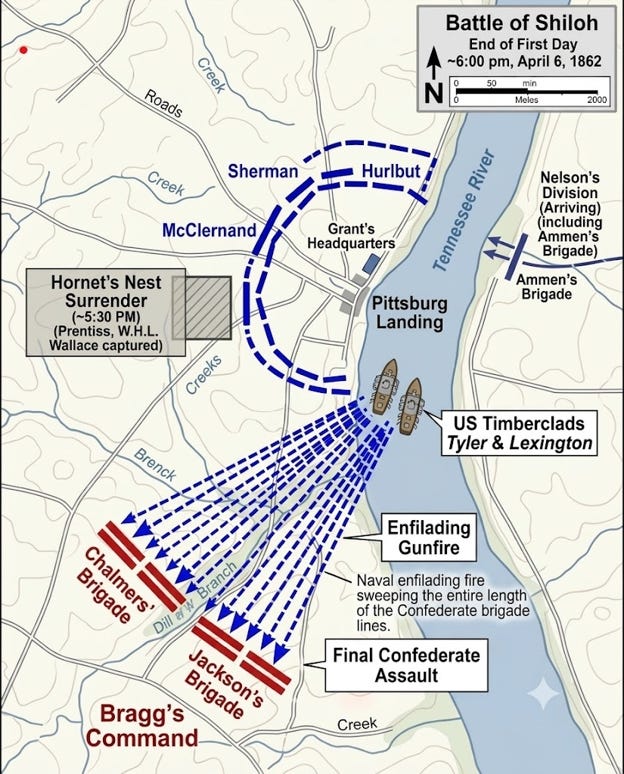
Culmination at Pittsburg Landing As Union forces consolidated near Pittsburg Landing, they did so with increasing coherence. Confederate forces, by contrast, arrived fragmented, advanced along separate axes, and lacked alignment for a unified assault. While tactical successes at the Hornet’s Nest created an illusion of victory, the true state of Confederate operational disintegration was laid bare during the final assault on Grant’s perimeter. Between 5:30 and 6:00 p.m., as Major General Braxton Bragg ordered a final push against Pittsburg Landing, only the brigades of Brigadier Generals James M. Chalmers and John K. Jackson could be marshaled into the steep, brush-choked terrain of the Dill Branch ravine. Exhausted and entirely out of ammunition, Jackson’s men were ordered to assault a highly consolidated defensive framework using only their bayonets. They were immediately shattered by the combined-arms dominance of Colonel Joseph D. Webster’s Grand Battery and devastating, close-range enfilading fire from the U.S. Navy timberclads Tyler and Lexington.
The structural collapse of the Confederate command was finalized when General P.G.T. Beauregard, blind to the tactical realities at the front and believing the victory complete, issued a universal cease-fire—unwittingly pulling back the only two brigades actively attempting to breach the Union line. While Confederate forces approached the landing piecemeal, Grant observed his own army successfully checking the advance, stating that once his final lines were re-established, the enemy’s fire was soon silenced.⁵ Time and daylight constraints further limited any hopes of Confederate reorganization,⁹ and the Confederate offensive culminated without achieving its objective.
Conclusion The Confederate failure on the first day of Shiloh was not the result of a single tragic turning point or a missed window of opportunity, but rather the inevitable culmination of a progressively degraded operational system. From the initial fragmented advance to the piecemeal assaults at the Hornet’s Nest and the Dill Branch ravine, the Confederate army steadily exhausted its combat power while failing to concentrate its assets for a decisive blow. The accumulation of localized tactical successes continuously fed a false perception of victory, blinding Confederate leadership to the reality that their offensive workflow had lost all structural coherence. In contrast, Union forces—despite severe initial disruption—retained enough localized cohesion to continually re-form, ultimately consolidating into an insurmountable, combined-arms defensive framework. The first day of Shiloh stands as a stark historical case study demonstrating that battlefield momentum without operational synchronization produces only illusionary gains. Ultimately, tactical success cannot substitute for systemic coherence.
Endnotes
Ulysses S. Grant, Personal Memoirs of Ulysses S. Grant (New York: Charles L. Webster & Co., 1885), 350–52.
The War of the Rebellion: A Compilation of the Official Records of the Union and Confederate Armies (Washington, DC: Government Printing Office, 1884), ser. I, vol. 10, pt. 1, 108.
Timothy B. Smith, Shiloh: Conquer or Perish (Lawrence: University Press of Kansas, 2014), 287–89; Larry J. Daniel, Shiloh: The Battle That Changed the Civil War (New York: Simon & Schuster, 1997), 215–18.
Steven E. Woodworth, Nothing But Victory: The Army of the Tennessee, 1861–1865 (New York: Alfred A. Knopf, 2005), 142–45.
Grant, Personal Memoirs, 350–52; Smith, Shiloh, 301–03.
Timothy B. Smith, The Untold Story of Shiloh: The Battle and the Battlefield (Knoxville: University of Tennessee Press, 2006), 112–15; Daniel, Shiloh, 222.
Official Records, ser. I, vol. 10, pt. 1, 392.
Official Records, ser. I, vol. 10, pt. 1, 466.
Larry J. Daniel, Shiloh, 230; Steven E. Woodworth, Nothing But Victory, 150.